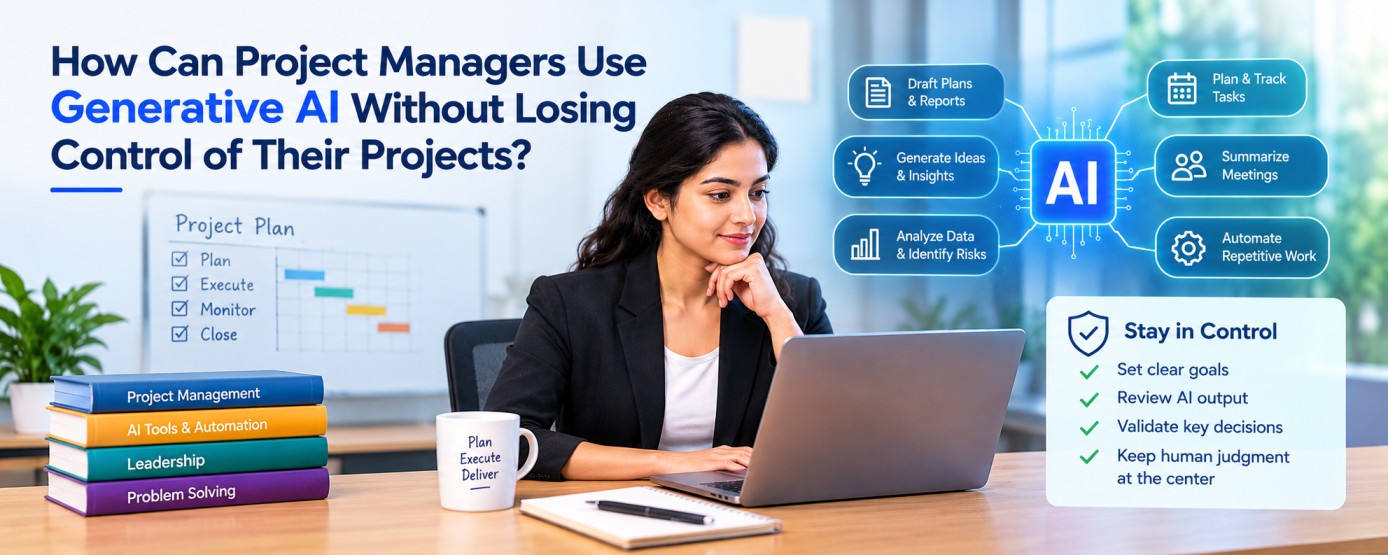
Generative AI is quickly being integrated into daily project management. It can prepare project documents, take meeting notes, analyze data, identify risks, and help make decisions. But more automation also raises a key concern: How can project managers leverage generative AI without losing control of their projects? Start your PMP Certification Journey for professionals who are preparing for the future of project leadership. They can build the structured project management knowledge needed to combine AI capabilities with human judgment. The idea is not to let AI run the project by itself but to use it as a controlled instrument that increases productivity while keeping the project manager responsible.
The case for a balanced view of AI by project managers
Generative artificial intelligence is able to process data much faster than a person. It can be used by a project manager to break down a long meeting, to analyze project updates, to generate an initial risk register, or to create a first draft of a stakeholder communication.
But speed does not necessarily mean accuracy.
AI-generated information can be wrong assumptions, out-of-date information, incomplete context, or recommendations that are not suited to the organization’s situation. When a project manager accepts every AI output without review, automation can create new risks instead of reducing them.
So the best approach is human-led, AI-assisted project management.
A project manager stays accountable for decisions. AI is helping with specific activities within well-defined boundaries.
How can generative AI help project managers?
Generative artificial intelligence can assist in many phases of the project lifecycle.
Planning your project
Artificial intelligence can assist project managers in organizing initial project information and producing draft planning materials.
For example, it can help with:
- Creating an initial work breakdown structure
- Writing the project objectives
- Recognizing Potential Dependencies
- Preparing draft project documentation
- Creating planning checklists.
- Drafting questions for stakeholder discussions
These outputs are to be viewed as starting points and not as the end points.
The project manager must review the information in light of real project requirements, organizational processes, available resources, and stakeholder expectations.
Meeting Management
Meetings often produce a lot of information that must be translated into action.
AI tools can help summarize conversations, surface decisions, surface action items, and help organize follow-ups.
This can save a lot of administrative time.
However, major decisions should be confirmed by project managers before they are recorded as official project decisions. A badly interpreted AI summary can muddle who has agreed to what or whether any requirement was even approved.
Risk Identification
Another area where standard artificial intelligence can be useful is risk management.
A project manager can share relevant project information and ask an AI tool to find potential risks, dependencies, or issues for attention.
This can be used to extend the thinking of the team.
But AI should not be the last word on risk.
The project manager and team still need to assess probability, impact, ownership, response strategies, and organizational context.
How do project managers maintain control?
To leverage AI properly, you must have governance in place, not just access to an AI tool.
1. Clarify what artificial intelligence can and cannot do.
Define the boundaries clearly before using generative AI.
For example, AI could be allowed to:
- summarize meetings
- Develop boilerplate communications
- Analyze non-sensitive project-level data
- Generate ideas for brainstorming.
- Supporting documentation
But the ultimate sign-off of budgets, scope changes, contractual decisions, major risks, and stakeholder commitments should rest with authorized people.
This simple distinction makes the difference explicable.
2. Humans in the approval loop
The project manager should review critical AI-generated outputs before such outputs affect the project.
Treat AI output as a suggestion, not a directive.
For instance, AI might recommend adding resources if a project milestone seems to be in jeopardy. Then the project manager needs to investigate whether the problem is really caused by resource capacity, unclear requirements, technical dependencies, or something else.
Human review adds the missing context.
3. Safeguard Sensitive Project Data
Don’t copy every project document into a public AI platform.
Project managers may be given access to confidential information, such as customer information, financial information, employee information, intellectual property, contracts, or strategic plans.
Before implementing AI, organizations should set rules for:
- What type of information can be fed into AI tools
- What AI platforms are allowed
- How we treat sensitive data
- Who has access to information generated by AI
- How to save outputs
AI adoption without information governance can lead to avoidable security and compliance risks when human review is needed.
4. Cross-Check AI-Produced Data
Generative artificial intelligence can produce factually wrong and seemingly plausible answers.
This is especially true when AI is used to make decisions about projects.
Project managers should verify key information from reliable sources, project documentation, organizational policies, and subject matter experts.
One useful principle is:
The greater the importance of the decision, the stronger the verification should be.
A small email draft might just need a quick once-over. Any major decision on scope, cost, legal, or delivery requires a much higher level of scrutiny.
Can AI Take Over Project Managers?
Artificial intelligence can assist in automating individual activities, but project management is far more than just getting the activities done. Project managers manage stakeholders, resolve conflicts, develop trust, understand organizational politics, motivate teams, deal with ambiguity, and make decisions with imperfect information.
These responsibilities need context and human accountability.
Think of a project where a key stakeholder disagrees with a proposed change. AI is able to summarize the disagreement and suggest communication approaches. But it cannot be responsible for the relationship or know all of the organizational factors affecting the stakeholder.
But the project manager still has to be the one to drive the conversation.
That’s why AI should be a capability multiplier, not a replacement for project leadership.
What Skills Will Project Managers Need in an AI-Driven Environment?
The more routine work AI takes over, the more critical human skills become.
Strategic Thinking
But project managers need to know how projects contribute to organizational objectives—not just schedules and tasks.
Critical Thinking
Professionals need to consider if AI-generated suggestions are logical, accurate, and appropriate.
Contact
AI is able to generate messages, but project managers still need to understand audiences and handle delicate conversations.
Risk Management
AI is able to spot potential risks, but it takes humans to determine which risks should be acted on.
AI Literacy
Project managers don’t need to be AI developers, but they do need to understand what artificial intelligence can and can’t do, its risks, and where it should and shouldn’t be used.
Ethical Decision-Making
AI-generated recommendations can have consequences for employees, customers, budgets, and organizations. Project leaders need to understand when to question or reject automation.
How Certification Can Help Project Managers Adjust?
When organizations adopt new technologies, professional certification can provide a structured foundation for project management.
It can also be used as a tool to help experienced project professionals buttress their knowledge in areas like planning, stakeholders, risks, delivery approaches, leadership, and business outcomes.
PgMP Certification Training can be a way for professionals aspiring to broader program-level responsibilities to build programme management knowledge. Programme managers coordinate related projects and are concerned with delivering larger benefits and strategic objectives for the organization. The important thing is that certification should be a complement to practical experience and technology awareness, not a substitute.
Training organizations such as Simpliaxis can assist professionals in building structured project and programme management knowledge as they advance in their careers.
A Practical Framework for Responsible AI Deployment
Project managers can take a five-step approach to bringing generative AI into project work:
1. Define: Identify the project activity to which artificial intelligence can add value.
2. Protect: Identify whether the data in use contains sensitive or confidential information.
3. Generate: Create a first draft using an approved AI tool.
4. Validate: Check the output against reliable project information and expert knowledge.
5. Decide: Retain final accountability and decision-making with the appropriate human stakeholder.
The framework helps organizations reap the productivity gains of AI while maintaining control.
The Future of AI and Project Management
Generative AI is likely to be increasingly embedded into project management platforms and organizational workflows.
More automation of routine reporting. Risk signals can be picked up earlier. Project documentation can require less manual work. Teams could get faster insights into projects.
But these improvements mean leadership is more, not less, important.
With machines taking over more administrative tasks, project managers can spend more time on the activities that create real organizational value: making decisions, solving difficult problems, building teams, managing stakeholders, and ensuring that projects achieve the outcomes they are intended to achieve.
Conclusion
Project managers don’t have to choose between using generative AI and maintaining control of their projects. A better way is to have clear boundaries, protect sensitive information, verify AI-generated outputs, and hold humans accountable for important decisions.
Artificial intelligence can cut down the time needed for project management and make it more efficient, but good leadership still requires judgement, experience, communication, and strategic thinking.
As professionals prepare for this changing environment, the combination of project management expertise, AI literacy, and responsible decision-making can be a powerful career advantage. Whether you are laying the groundwork for knowledge or progressing towards advanced project and programme leadership, structured learning can help professionals stay ready as AI transforms how projects are delivered.
Visit our website for more.