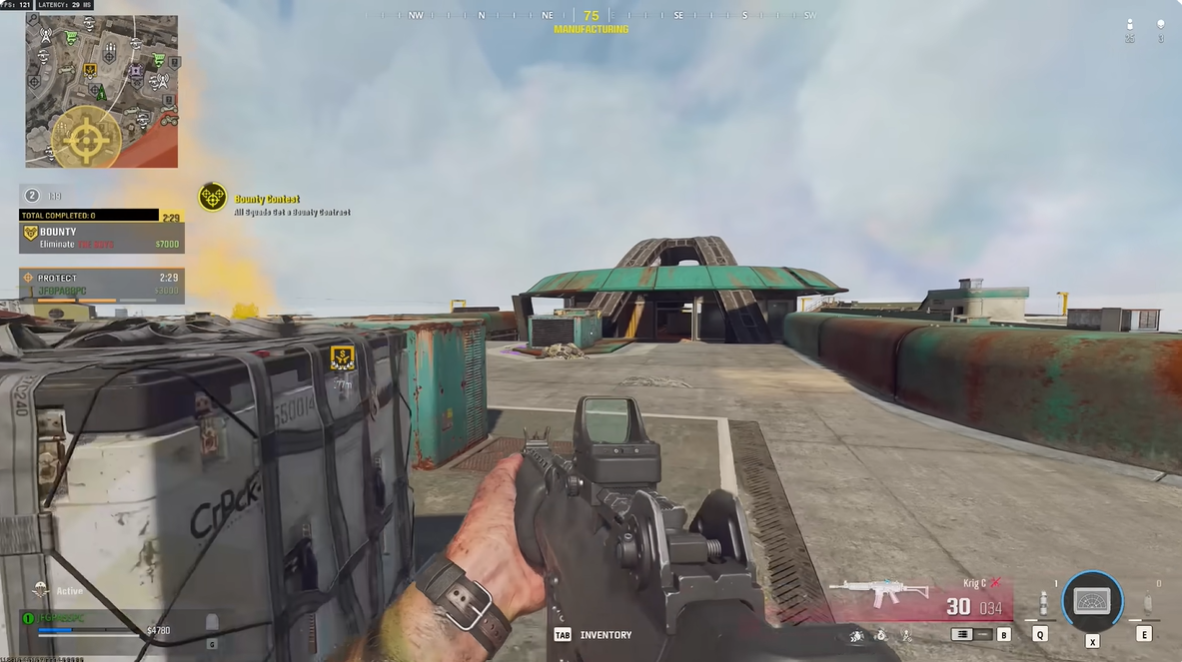
Here’s a question that separates good Warzone players from great ones: do you push, or do you hold?
Most players already have their answer. The aggressive ones W-key everything. The passive ones hide until final circle. And both groups wonder why they’re stuck at the same rank.
The reality? Neither style wins consistently on its own. The players climbing SR and stacking wins are the ones who switch between the two—deliberately, based on information, not instinct.
That’s the difference between smart aggression and dumb aggression. Between smart patience and just… camping.
Let’s break down exactly when each approach works, why the 2026 meta rewards hybrid players, and how to stop making the mistakes that keep most squads hardstuck.
What Smart Aggression Actually Looks Like
Smart aggression isn’t “push everything.” It’s pushing when the math is in your favor—and knowing what that math looks like in real time.
You have full plates. Your squad is together. You’ve got a UAV sweep showing one isolated duo nearby. Their armor is cracked from a fight they just barely survived. That’s a smart push.
Compare that to chasing gunshots 300 meters across open ground with no intel and half your plates missing. Same aggression. Completely different outcome.
Triggers for Smart Aggression
- Intel advantage: UAV, audio cues (reloading, reviving), or visual confirmation of a weak squad
- Resource advantage: Full plates, loaded utility, cash for buybacks
- Positional advantage: You hold high ground or control the angle they need to rotate through
- Tempo advantage: Mid-to-late game where SR per kill jumps significantly—especially with 1–3 squads remaining, where each elimination can net +15 SR
The common thread? Every smart aggressive play starts with information, not emotion.
What Smart Patience Actually Looks Like
Smart patience isn’t sitting in a corner. It’s actively controlling space and forcing enemies into bad decisions while you wait for the right moment.
You’ve locked down a rooftop overlooking a rotation path. Two squads are fighting below. You’re not shooting yet—because the second you reveal your position, the survivor of that fight turns on you. So you wait. Let them trade damage. Then clean up what’s left.
That’s not ratting. That’s high-IQ play.
When Patience Wins
Zone control matters most when you already have position. If you’re sitting in next circle on high ground, there’s almost no reason to give that up for a kill across the map.
Patience also wins when resources are thin. Low plates, no cash, missing a teammate—these are signals to slow down, not speed up. Over-aggression while resource-starved is one of the most common ways squads throw winning games.
And in solos or duos? Patience is even more critical. Fewer guns means every mistake costs more. One bad peek and you’re back in the lobby.
The 2026 Meta Rewards Both—At Different Times
Here’s why this matters right now. The current ranked system in BO7 Warzone explicitly rewards both placement and eliminations. But the weighting shifts as the match progresses.
Early kills? They give modest SR. Late-game eliminations with 1–3 squads left? Up to +15 SR each. Meanwhile, deployment fees for higher-ranked players can hit -210 SR for a bad game.
Translation: dying early while kill-chasing is brutally expensive. But hiding all game and finishing with zero kills barely moves your SR either.
The players at the top of leaderboards consistently show balanced stat lines—solid K/D paired with strong top-placement finishes. Not extremes in either direction.
A Simple Decision Framework
Forget complicated flowcharts. When deciding whether to push or hold, ask one question:
“Do we win this fight 8 out of 10 times?”
If yes, push. If not, reposition. That’s it. Elite players run this mental check constantly. It accounts for plates, positioning, numbers, intel, and zone pressure all at once.
By Game Phase
Early game: Aggression works if you’ve landed contested and secured a gun/plate advantage. Snowball the economy early through wipe rewards and contracts.
Mid game: Mixed. Punish rotating squads caught in the open. Third-party weakened teams. But don’t chase fights that pull you away from zone.
Late game: Precision aggression only. Take decisive fights to secure power positions before the circle forces chaos. This is where kills are worth the most SR—but also where bad deaths are most punishing.
The Mistakes That Keep You Stuck
When Aggression Turns Reckless
Re-peeking the same angle after getting cracked. Pushing a full squad solo because “they’re one-shot” (they never are). Chasing a team into zone because you want the finish. Splitting from your squad to ego-challenge a head-glitch.
If most of your deaths happen while pushing off-zone, solo, or without full plates—you’re not playing aggressive. You’re throwing.
A simple fix: never push without full plates and at least one piece of utility. Never ego-peek the same angle twice. These two rules alone will cut reckless deaths dramatically.
When Patience Turns Passive
Sitting in a low-ground building, ignoring contracts, rotating late through gas with no plan. If you consistently reach late game with minimal damage and few contracts completed, you’re not being patient—you’re being useless.
Set a floor: one contract and one proactive rotation per circle. That keeps patience active instead of idle.
Loadouts That Support Each Style
Your loadout should match your intended tempo—not fight against it.
Aggressive builds lean toward meta SMGs like the Carbon 57 or Dravec 45 with mobility attachments, paired with snappy ARs like the AK-27 or MXR-17 for mid-range fights. Stims, stuns, and Semtex round out the kit for fast entries.
Patient builds favor long-range ARs or snipers—the Strider 300 and DS20 Mirage are popular picks—configured for stability and suppression. Trophy systems, deployable cover, and recon contracts support holding positions without giving away your location.
Most top players run a hybrid: one aggressive weapon and one patient weapon. That way the loadout doesn’t force a playstyle the situation doesn’t call for.
Reading the Lobby and Switching Modes
The best players don’t commit to a style at the start of a match and ride it out. They read the lobby—checking killfeed speed, early SR gains, contract density, and how quickly squads are dying—and adjust tempo accordingly.
Sweaty lobby with fast wipes? Lean patient toward end-game. Slower lobby with lots of surviving squads? Controlled aggression can snowball into a dominant position.
This is where tools like aimbot hacks available on Battlelog can sharpen your edge—giving you the kind of enhanced awareness and mechanical consistency that makes mode-switching between aggression and patience far more effective in practice.
The Bottom Line
Smart aggression and smart patience aren’t opposing philosophies. They’re two modes that elite Warzone players flip between constantly, based on information, resources, and game state.
The players who climb aren’t the ones with the most kills or the most wins. They’re the ones who consistently make the right call about when to fight and when to wait.
Stop identifying as “aggressive” or “passive.” Start identifying as adaptable. That’s the real meta in 2026—and it always has been.